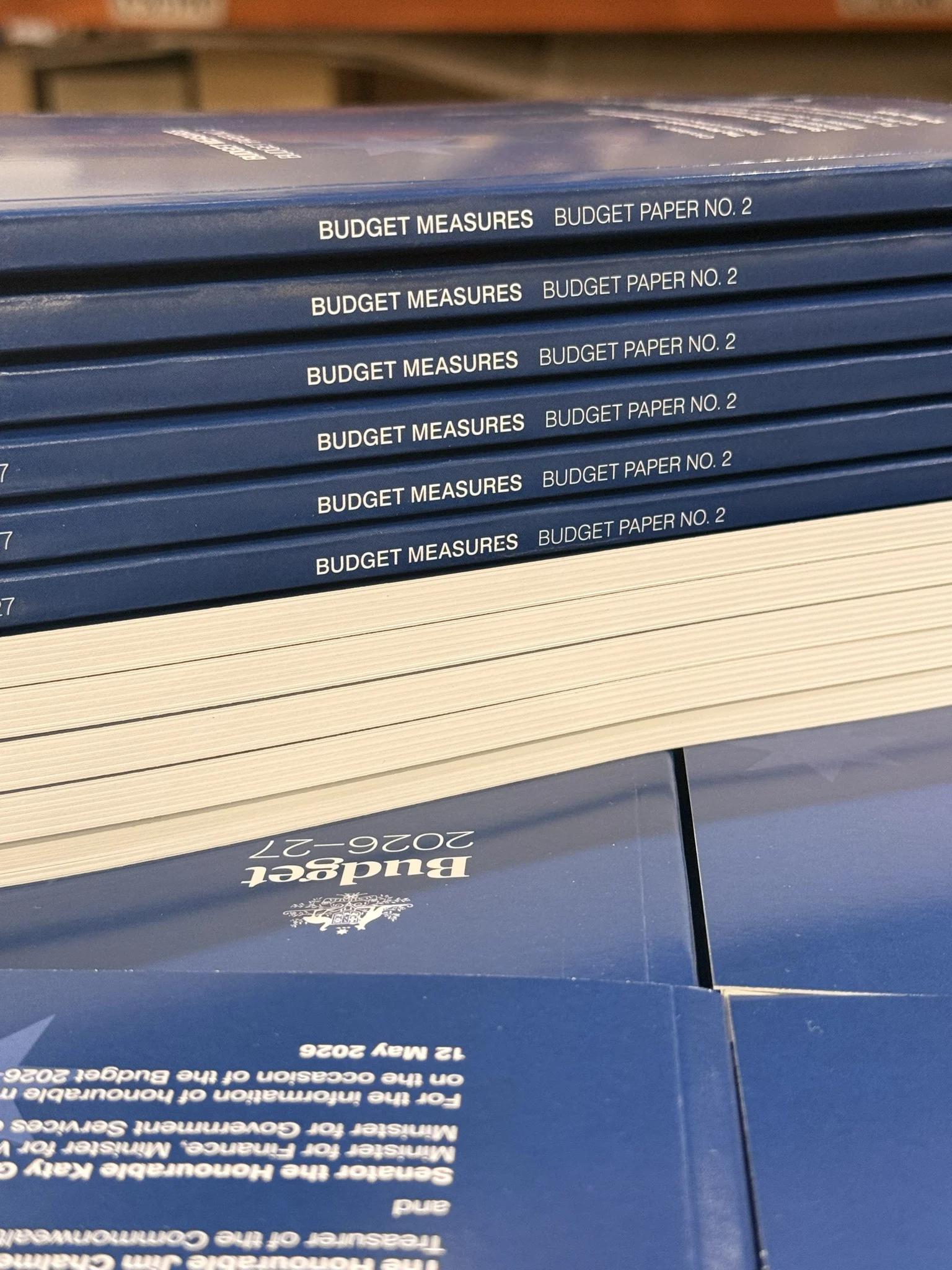
Federal budget 2026-27: what HACCI members need to know
By Peter Zervos, HACCI Treasurer
As HACCI members and subscribers, you will be looking at what this federal budget means for business confidence, costs and investment.
The Budget contains one of the most substantial tax reform agendas in more than two decades, with implications for investors, family businesses, professional services, and corporate structures. The proposed changes include replacing the long-standing 50 per cent capital gains tax discount, restricting negative gearing to newly built homes, and introducing a 30 per cent minimum tax on discretionary trusts.
Changes to capital gains tax
From 1 July 2027, the existing 50 per cent capital gains tax discount for individuals, partnerships, and trusts would be replaced with a new two-part system.
The first change reintroduces indexation for assets held longer than twelve months, linking asset values to inflation through the consumer price index. The aim is to tax only the real gain made on an asset.
The second introduces a minimum effective 30 per cent tax rate on indexed capital gains. If a taxpayer’s effective rate falls below 30 per cent, additional tax would apply to bring it up to that level. The measure is designed to reduce the practice of selling assets during lower-income years to minimise tax.
The reforms extend beyond property and apply to a broad range of investments, including shares, funds, private equity, and business assets. Companies are excluded, as they do not currently access the CGT discount.
Several existing concessions remain in place, including the main residence exemption, small business CGT concessions, and the affordable housing discount. Superannuation funds are also excluded from the changes.
Assets held before 1 July 2027 would have gains apportioned between the existing CGT discount and the new indexed system. Investors in newly built residential properties would also have the option to choose between the existing CGT discount and the new indexed model when selling eligible assets.
Negative gearing
From 1 July 2027, investors would no longer be able to deduct losses from existing residential investment properties against income such as wages or business earnings. Instead, losses would be quarantined and only offset against future residential property income or capital gains. Unused losses could still be carried forward indefinitely.
The changes would apply to individuals, companies, partnerships and most trusts. Managed investment trusts and superannuation funds, including SMSFs, would remain exempt. Commercial property and investments such as shares would not be affected.
Importantly, existing property owners would be protected under grandfathering arrangements. Properties owned before 7:30pm AEST on 12 May 2026, including those already under contract at the time of the announcement, could continue accessing negative gearing under the current rules. Properties acquired between the announcement date and 1 July 2027 would continue operating under the existing rules until the changes take effect.
The reforms are designed to preserve concessions for projects that add to housing supply. Newly built properties on vacant land, or developments increasing dwelling numbers, would still qualify for negative gearing. However, renovations, granny flats, and knockdown rebuilds without additional dwellings would not qualify.
The concession would apply only to the first investor purchaser of a new build. Future buyers of the same property would lose access to both negative gearing concessions and the 50 per cent CGT discount.
Build-to-rent projects and investors participating in government-backed affordable housing programs would also remain exempt under the proposed changes.
New minimum tax for discretionary trusts
From 1 July 2028, discretionary trusts would face a minimum 30 per cent tax on trust income, regardless of how income is distributed to beneficiaries. Higher marginal tax rates would still apply where relevant.
Under the proposed model, trustees would continue allocating income to beneficiaries each year, but the trust itself would pay the initial 30 per cent tax. Beneficiaries could use tax credits against their own liabilities, although refunds would not apply where personal tax rates fall below 30 per cent.
The reforms are designed to limit income-splitting strategies commonly used through family trusts and bucket company arrangements. Corporate beneficiaries would not receive refundable credits, reducing the effectiveness of routing trust income through private companies.
The changes would apply only to discretionary trusts. Fixed trusts, superannuation funds, charitable trusts, deceased estates and most testamentary trusts would remain exempt. Certain income categories, including primary production income and some non-resident income, would also be excluded.
The government would also introduce a three-year rollover relief period from 1 July 2027, allowing eligible businesses to restructure from discretionary trusts into companies or fixed trusts without immediate capital gains tax consequences.
For property investors using discretionary trusts, the combined impact of the reforms could significantly increase long-term tax costs. Existing investments would retain some grandfathering protections, but future residential property acquisitions inside discretionary trusts would face tighter negative gearing rules, revised CGT treatment and the new minimum trust tax.
The combined reforms could significantly reshape how Australians structure investments and businesses.
Property investors using discretionary trusts may face higher long-term tax costs, particularly for future residential property purchases.
New acquisitions may be more attractive outside discretionary trusts.
What it means for investors and businesses
The combined reforms could significantly reshape how Australians structure investments and businesses. Property investors using discretionary trusts may face higher long-term tax costs, particularly for future residential property purchases that no longer qualify for full negative gearing and concessional CGT treatment. Existing investments retain some grandfathering protections, but new acquisitions may be more attractive outside discretionary trusts.
The changes also target income-splitting strategies commonly used by family groups, professional services firms, and bucket company structures. Distributions to lower-income beneficiaries would become less effective under the proposed 30 per cent minimum trust tax, prompting many businesses to review existing arrangements.
For SMEs, the reforms reduce the tax advantages traditionally associated with discretionary trusts, potentially making company structures more attractive for future business setups. While small business CGT concessions remain unchanged, businesses considering restructuring would need to weigh up tax outcomes, asset protection and potential state stamp duty costs.
A proposed three-year rollover relief period from 2027 to 2030 would allow eligible businesses to restructure into companies or fixed trusts without immediate CGT consequences, although state-based taxes and compliance costs may still apply.
While the reforms are still subject to consultation, the budget signals a clear shift in how Australia taxes investment, trusts and business structures. For investors and SMEs, the coming years may require a rethink of long-standing tax and planning strategies.
As always, some measures still need to pass Parliament. We encourage members to treat the budget as a signal, not a final operating manual.
This is the time to review your investment plans, update your forecasts, check your eligibility for small business measures, and seek advice before making major tax, property or business decisions.
HACCI will keep monitoring the detail and sharing updates that matter to Victorian business.
This article provides general information only and does not constitute financial, legal or tax advice. Members should seek advice based on their own circumstances.